How fast you should act on your pet's allergic reaction depends on which kind you are looking at: weeks of itching calls for a regular appointment in the next day or two, hives and facial swelling should be seen today, and anaphylaxis needs a veterinarian within minutes. In a severe reaction, the immune system releases a flood of histamine and other chemicals all at once; vessels leak, blood pressure drops, the airways narrow, and every one of those gets harder to reverse the longer it runs. Early on, the reaction that fizzles out on its own and the one that does not look exactly the same, which is why "let's wait and see if it passes" is the single plan we would ask you to skip. Showing up early with your pet, only to learn they are fine, is not an overreaction; it is the outcome we are rooting for.
Animal Hospital Southwest in Fort Worth sees urgent and emergency cases the same day, so if your pet's face is swelling or their breathing has changed, call ahead and come straight to our AAHA-accredited hospital; after hours or on a weekend, head to the nearest 24/7 veterinary ER rather than waiting for us to open. Fort Worth supplies the fire ants, the pollen, and the wasps that think your porch is their home, making allergic reactions of all levels a possibility. For the slower, itchier kind of allergy we can work out what is driving it and pair treatment with medicated baths from our groomers to knock back the skin infections that tag along with chronic scratching. If your pet has been scratching, licking, or chewing at themselves for more than a couple of days, book an appointment online and let us get ahead of it.
Allergic Reactions at Three Speeds
- Allergic reactions come in three tiers: chronic itchy skin that needs an appointment soon, hives and facial swelling that need care today, and anaphylaxis that needs a veterinarian within minutes.
- Anaphylaxis looks different by species, with dogs often vomiting and collapsing while cats struggle to breathe, and open-mouth breathing in a cat is never normal.
- Human combination allergy, cold, and pain medications can be dangerous for dogs and cats. Nothing from the medicine cabinet goes in your pet without a veterinarian's direction.
- Chronic allergies get controlled rather than cured, and a layered plan of parasite prevention, medicated topicals, prescription medication, and sometimes immunotherapy keeps most pets comfortable.
Which Allergic Reactions Need a Vet Right Now?
Trouble breathing, collapse, sudden vomiting with weakness, or a change in gum color all mean go now. Gum color is the closest thing you have to a live readout of circulation, and pale or bluish gums mean the reaction has left the skin and reached the bloodstream.
| Tier | How fast to act | What you're seeing |
| Chronic and itchy | Appointment in the next day or two | Constant scratching, paw licking, recurring ear infections, hair loss, scabs, odor |
| Sudden but stable | Same day, call ahead | Hives, a puffy muzzle or eyelids, a sting with local swelling, a new raw sore |
| Systemic | Immediately | Labored or open-mouth breathing, pale or blue gums, collapse, repeated vomiting and diarrhea, throat or tongue swelling |
Our team handles emergency and urgent care during our open hours. The fastest move is a phone call while someone else drives. Here's what helps on the way in.
- Note the clock: write down when the swelling or itching started and what your pet ate, chewed, or got stung by in the hour before.
- Skip the medicine cabinet: no human combination antihistamine, cold tablet, or pain reliever, because the decongestants and NSAIDs mixed into those products are dangerous for dogs and cats.
- Don't induce vomiting: unless a veterinarian has told you to, leave the stomach alone.
- Bring the suspect: the treat bag, the chew, a clipping of the plant, or a photo of the insect gives us a head start.
- Watch the breathing: effort, noise, or an open mouth means tell us the moment you walk in.
What Does Anaphylaxis Look Like in a Dog or a Cat?
Anaphylaxis in dogs tends to announce itself through the gut, with sudden vomiting, diarrhea, weakness, and collapse inside of minutes. No wonder it gets mistaken for something they ate. Cats go the other way, hitting the airways first: a mouth that shouldn't be open, a crouched posture, drooling, and sudden weakness. Dogs may show hives and a swollen face first, or nothing on the skin at all. Most severe reactions begin within minutes to an hour of a sting, a vaccine, or a new medication, and they build instead of leveling off. Skin signs are optional. The crash is not.
Are Hives and Sudden Swelling Something to Treat Today?
Hives and a swelling muzzle need a same-day visit, even when your dog seems fine otherwise. Welts rise within minutes to a few hours of exposure, and while many settle with treatment, hives can also be the opening act of a severe reaction.
Most stings are a sore, puffy spot that improves overnight. They cross into urgent territory when they land on the face, in the mouth, or in the throat, when there are several at once, or when swelling arrives alongside vomiting, weakness, or a change in breathing. A curious puppy who snaps at a wasp gets a same-day look.
A cat crouched low with her neck stretched out, producing what looks like a hairball attempt with nothing at the end of it, is often showing feline asthma, allergen-triggered airway narrowing that can slide from a cough to an emergency in minutes. Allergic bronchitis does something similar in dogs when the air is thick with pollen or smoke. If your pet is coughing, wheezing, or itching without a break, call us and come in today.
What's Setting Off My Pet's Allergies?
Most allergic pets are reacting to one of three things: what's in the air, what's in the bowl, or what bites them.
- Environmental: pollen, grass, mold, and dust mites are the big four behind atopic dermatitis. It usually starts as a seasonal itch and creeps toward year-round as a pet gets older.
- Food: the culprit is usually a protein a pet has eaten happily for years, with beef, chicken, dairy, and fish leading the list. The giveaway is itching that runs all twelve months with no seasonal break.
- Insects and parasites: flea bites sit at the top, followed by bees, wasps, and the fire ants that treat a Fort Worth backyard as prime real estate.
Plenty of pets carry two of these at once, and the symptoms look nearly identical from the outside. That is the reason the workup beats the guess.
Can a Vaccine or a New Medication Cause a Reaction?
Most dogs and cats get through vaccines with nothing worse than some soreness or a long afternoon nap, while facial swelling, hives, vomiting, or labored breathing within a few hours are vaccination reactions that need a phone call the moment you notice them. Antibiotics, anti-inflammatories, and occasionally a topical parasite product can do the same thing. Tell us if your pet has ever reacted to anything, even mildly and even years ago, because that history changes how we schedule, premedicate, and monitor. We go back over it at twice-yearly wellness exams and immunizations so that nothing new goes in without that context.
Why Is My Pet Scratching, Licking, and Chewing Nonstop?
Relentless scratching, licking, and chewing usually means allergic skin disease, the slow version of the same immune overreaction. It rarely settles on its own, because a damaged skin barrier lets yeast and bacteria move into the gaps, and those infections stack a second itch on top of the first. Not every itch is an allergy: Sarcoptes mites cause a contagious mange that spreads to other animals and to people, and it mimics allergic skin disease closely enough that a skin scraping belongs in the first workup.
The patterns split by species:
- In dogs: hot spots are raw moist sores that go from pinpoint to palm-sized in a day. Pododermatitis leaves the skin between the toes red, swollen, and rust-stained from constant licking. Chronic otitis externa, the head-shaking, smelly, keeps-coming-back kind of ear infection, is more often an allergy problem than an ear problem.
- In cats: cats groom in private, and hair loss is usually the first thing anyone notices, with bald strips along the belly, inner thighs, or flanks and healthy skin underneath. Miliary dermatitis is a scatter of small crusty bumps you feel along the back before you see them. Raised, ulcerated sores on the lip, chin, belly, or the back of a thigh point toward eosinophilic granuloma complex, more common in cats with flea allergies.
How Do We Treat an Allergic Reaction?
Treatment splits the same way the reactions do: a severe one gets stabilized first and explained afterward, while chronic allergic skin disease gets a layered plan built over weeks.
Emergency Treatment for a Severe Reaction
Epinephrine goes first, because it's the only drug that reverses the drop in blood pressure and opens the airways at the same time. An IV catheter follows for fluids and further medication, oxygen supports the lungs while swelling comes down, and antihistamines plus corticosteroids blunt the rest of the immune response. From there it's continuous monitoring of blood pressure, heart rhythm on ECG, and breathing. A second wave can arrive hours after the first one quiets. Patients stay with us well past the point where they look fine.
Treating Chronic Skin and Ear Allergies
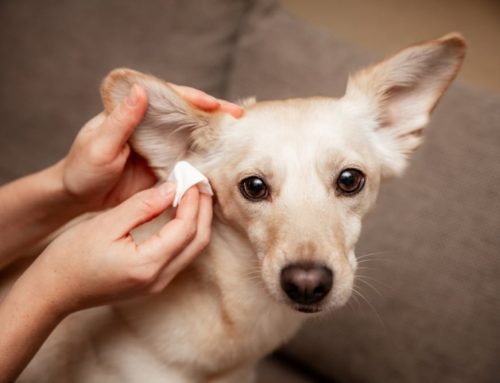
The plan runs in order: clear any infection, stop the itch with something fast, then treat the allergy underneath. Before anything goes into an infected ear, ear cytology shows whether yeast, bacteria, or both are driving this particular flare. Our video otoscopy shows the full canal down to the eardrum when an ear has been infected on and off for a year.
What Keeps the Next Flare From Happening?
Prevention works in layers, and no single one carries a pet by itself.
- Flea control, year-round, for every pet in the house: in a sensitized pet, flea allergy dermatitis turns one bite into weeks of itching. "I never see fleas on him" is not evidence that fleas are staying out of it. Mild North Texas winters mean prevention runs all year here, including for the cat who never sets foot outside. Ask us which flea and tick prevention fits your pet.
- Medicated baths, mousses, and wipes: topical therapy puts anti-itch, antimicrobial, and barrier-repairing ingredients where the trouble is, which often lowers how much oral medication a pet needs. Medicated shampoo needs at least ten minutes of contact time before rinsing. Between baths, sprays, mousses, and wipes cover the spots that break down first: facial folds, feet and between the toes, and ears. Our veterinarians match the ingredients and the schedule to your pet's skin.
- Grooming, home changes, and fatty acids: regular grooming and bathing lifts pollen out of the coat before it gets licked off or absorbed. Wiping paws, face, and belly after outdoor time does the same job daily. Indoors, a HEPA filter and bedding laundered weekly in hot water knock down the dust mite load, and omega-3 fatty acids strengthen the skin barrier over a couple of months.
Prescription Medications for Allergies
Most allergic pets use more than one option across a year, moving between them as the pollen count and their skin change. Not every medication is right for every allergy or every pet, and we’ll set up a plan that works for both their health needs and your lifestyle.
| Option | What it does | How it's typically used |
| JAK inhibitors | Block the itch signal at its source | Daily tablet, relief within hours, for flares or longer stretches |
| Cytopoint | Antibody injection that neutralizes one itch protein | Every 4 to 8 weeks for established atopic dermatitis |
| Cyclosporine (Atopica) | Modulates an overreacting immune system | Daily, several weeks to full effect, built for long-term control |
| Corticosteroids | Fast, broad anti-inflammatory | Short courses for acute flares, not a long-term plan |
| Antihistamines | Mild histamine blocking | Helps a subset of pets, usually as an add-on |
JAK inhibitors quiet the itch within hours rather than days, and the class now runs with Apoquel, Zenrelia, and Numelvi, which means pets have multiple options. For a pet with a confirmed history of anaphylaxis, an epinephrine auto-injector at home is a case-by-case recommendation. It buys minutes on the drive to a hospital; it doesn't replace the visit.
Can Allergies Be Cured?
Allergies get controlled, not cured. The immune system doesn't unlearn a trigger, but two approaches shrink the problem instead of quieting symptoms: testing and immunotherapy for environmental allergies, and a strict elimination trial for food allergies. Both take months.
Allergy Testing and Immunotherapy
The hair and saliva kits you can order online are unreliable consumer allergy tests, returning the same long lists of positives for healthy pets as for itchy ones. A usable answer comes from serum testing, which starts with a blood sample drawn here, or from intradermal skin testing, which a veterinary dermatologist performs on referral. Either route produces a custom immunotherapy formula, given as sublingual drops or as injections, that retrains the immune response over twelve to eighteen months. Up to 80% of pets show a meaningful drop in symptoms, which makes it the one approach aimed at the cause.
Diet Trials for Food Allergies
No blood test settles a food allergy. The answer comes from an elimination diet trial: eight to twelve weeks on one novel or hydrolyzed protein with nothing else crossing your pet's lips, then a deliberate reintroduction to confirm what you found. A novel protein is one your pet has never eaten, like rabbit or venison, while a hydrolyzed protein has been chopped into pieces too small for the immune system to recognize. Over-the-counter limited-ingredient foods don't work for this, since the same production lines run multiple recipes and trace proteins ride along. Strict means strict: no treats, no flavored chews, no crumbs under the table.
Frequently Asked Questions About Allergic Reactions in Pets
Can I give my dog Benadryl at home?
Plain Benadryl is sometimes appropriate, but the dose needs to come from us, and the bigger issue is what else is in the box. Combination products that add a decongestant like pseudoephedrine or a pain reliever like acetaminophen can be dangerous or fatal for dogs and cats, and the packaging doesn't make that obvious. Plain diphenhydramine helps some mild reactions and does very little for a severe one. It's never a reason to stay home. Call us first, and start driving if breathing is involved.
How young can allergies start?
Environmental allergies usually surface between six months and three years of age. A puppy chewing their feet raw or a kitten on a second ear infection before the first birthday isn't too young to be allergic. Food allergies can begin at any age, including in a pet who has eaten the same diet for years without complaint. Early signs are easy to write off as a phase, and getting ahead of them saves years of secondary infections.
Will grain-free food stop the itching?
Grain-free food rarely stops the itching, because grain allergies are uncommon in dogs and cats and animal proteins are the usual offenders. Switching to a grain-free version of the same chicken recipe often changes nothing at all. A casual switch can also burn through a novel protein you might need later for a proper trial. If food is on your list of suspects, a supervised elimination trial is how you get an answer worth acting on.
Let's Get Your Pet Out of the Itch Cycle
Treating one flare at a time wears everybody down. Finding the trigger and building a plan around it is the difference between four ear infections a year and a dog who sleeps through the night, and it's much easier to start in a calm exam room than in the middle of an emergency. Book an allergy visit at Animal Hospital Southwest in Fort Worth, and let's get your pet comfortable again.